Year-End Tax Planning for Business Owners: What to Review
Review the key areas of your business before year-end to project taxes, identify tax-saving opportunities, and implement the right strategies by applicable deadlines.
Tax, Accounting, & Advisory Services
Tax, Accounting & Advisory Services
DuPage Tax Solutions provides tax preparation, accounting, bookkeeping, and proactive tax advisory services for individuals and businesses.
Based in Naperville, IL, we serve clients throughout the Chicago metropolitan area and nationwide through our secure, remote-first approach.
Licensed professionals. Reliable financial information. Proactive guidance throughout the year.

Home » Year-End Financial Review for Business Owners
As the year winds down, it’s a good time to review more than just your bank balance.
Your financial statements can show how your business performed during the year, what you owe, what customers owe you, and whether your books accurately reflect what is happening in the business.
Reviewing this information before the year ends also gives you an opportunity to correct bookkeeping issues and provide your tax professional with more reliable information for tax projections and year-end planning.
Start with your year-to-date profit and loss statement.
Your profit and loss statement summarizes your business income and expenses and shows whether the business generated a profit or loss during the period.
Review:
Don’t focus only on the bottom-line profit. Compare the numbers with what you know happened in the business.
For example, if revenue increased significantly but profit decreased, look at which expenses increased and why. If an expense category looks unusually high or low, investigate it before assuming the financial statement is correct.
For many businesses, taxable income begins with the financial information recorded in the books. If income or expenses are incomplete or incorrectly categorized, a tax projection based on those numbers may also be inaccurate.
Learn more about why accurate bookkeeping matters for year-end tax planning.
The balance sheet provides a snapshot of what your business owns and owes at a particular point in time.
Business owners sometimes focus heavily on the profit and loss statement while paying much less attention to the balance sheet. But balance-sheet accounts can reveal bookkeeping problems that affect the reliability of your financial information.
Review balances for:
Ask whether the balances make sense based on what you know about the business.
A loan that has already been paid off shouldn’t still show a large balance. A bank account shouldn’t differ significantly from the reconciled bank balance. Old receivables may represent customers who haven’t paid—or transactions that need to be corrected.
A reconciled bank account is only one part of tax-ready bookkeeping.
If customers owe your business money, review your accounts receivable before the year ends.
Look for:
This review isn’t only about bookkeeping. It can also help you understand how much of your reported sales has actually been collected and how much cash may still be coming into the business.
If an amount appears uncollectible, discuss it with your tax professional before making an adjustment. The tax treatment can depend on your accounting method and the circumstances.
Review bills and expenses that the business owes or has incurred.
Make sure legitimate business expenses have been recorded and check whether unpaid bills are accurately reflected in your accounting system.
This is also a good time to look for:
The goal isn’t simply to find more deductions. It is to make sure the books accurately reflect the business’s actual activity.
Did the business purchase equipment, vehicles, computers, furniture, machinery, or other significant assets during the year?
Make sure those purchases are identified correctly in the books.
Large purchases shouldn’t automatically be treated the same way as ordinary operating expenses. Depending on the asset and the circumstances, different depreciation or expensing rules may apply.
Before making additional purchases solely for tax reasons, discuss the decision with your tax professional. A deduction does not make an unnecessary purchase financially beneficial.
If your business has employees, review payroll information before year-end reporting begins.
Check:
S corporation owners should also review their compensation with their tax professional. Shareholder-employees are generally required to receive reasonable compensation for services performed for the corporation.
Waiting until tax-return preparation to discover a payroll or compensation issue can leave fewer options for addressing it properly.
Review the federal and state estimated tax payments you have already made during the year.
Your tax professional will need accurate payment information when preparing a tax projection and, eventually, your tax returns.
Also consider whether your business results have changed significantly from what you expected earlier in the year.
If income is substantially higher or lower than anticipated, your estimated tax situation may have changed as well.
A year-to-date report tells you what has already happened. Tax planning also requires looking ahead.
Consider what you reasonably expect between now and December 31:
These expectations can be combined with your year-to-date financial results to develop a more useful tax projection.
Reviewing these numbers isn’t the end of the process.
It creates the foundation for the next steps:
Accurate books help establish where the business stands today.
A tax projection estimates where your tax situation may end up based on year-to-date results and expected activity for the remainder of the year.
With that information, you and your tax professional can evaluate planning opportunities that may be appropriate for your circumstances—and determine whether action needs to be taken before the year ends.
Learn more about our year-end tax planning services.
Some planning opportunities cannot simply be recreated after December 31.
Review the key areas of your business before year-end to project taxes, identify tax-saving opportunities, and implement the right strategies by applicable deadlines.

An S-Corp may reduce taxes for some business owners, but there is no magic profit threshold. Learn what factors determine whether it makes sense.
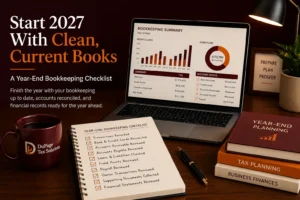
Use this year-end bookkeeping checklist to review your accounts, transactions, payroll, and financial statements so you can start 2027 with clean, current books you can rely on.
Tax season is primarily about reporting what already happened.
A year-end financial review gives you an opportunity to understand your business’s financial position while there may still be time to address bookkeeping issues and evaluate tax-planning opportunities.
If your books are incomplete, months behind, or contain balances you can’t explain, catch-up bookkeeping can be an important first step. Use our year-end bookkeeping checklist to see what should be reviewed before closing out the year.
Know where your business stands before the year ends.
Schedule a free consultation to discuss your bookkeeping, tax projection, and year-end planning needs.
Ph. (630) 909 9700
Email: DPTax@DP-Tax.com
Mail address:
1552 Illinois Rte 59 #1037
Naperville, IL 60564
Mon: 11 am – 7 pm
Tue: 11 am – 7 pm
Wed: 11 am – 7 pm
Thu: 11 am – 7 pm
Fri: 11 am – 7 pm
Sat: 12 pm – 5 pm
Sun: CLOSED
© 2024 DuPage Tax Solutions | Site Map | Privacy Policy | Disclaimer