When Should an LLC Consider an S-Corp?
An S-Corp may reduce taxes for some business owners, but there is no magic profit threshold. Learn what factors determine whether it makes sense.
Tax and Accounting Services
Tax, Accounting & Advisory Services
DuPage Tax Solutions provides tax preparation, accounting, bookkeeping, and proactive tax advisory services for individuals and businesses.
Based in Naperville, IL, we serve clients throughout the Chicago metropolitan area and nationwide through our secure, remote-first approach.
Licensed professionals. Reliable financial information. Proactive guidance throughout the year.

Home » Year-End Tax Planning for Business Owners: What to Review
Many business owners begin thinking seriously about taxes when it is time to prepare the tax return. At that point, however, the tax year has already ended. The return can report what happened, but many opportunities to change the outcome may no longer be available.
That is why the final months of the year are an important time for year-end tax planning.
Effective year-end tax planning is not simply estimating how much you will owe or making another estimated tax payment. It means looking at your business and overall tax situation while there is still time to evaluate your options and make informed decisions.
A useful way to approach the process is:
PROJECT → PLAN → IMPLEMENT
Some strategies must be completed before December 31. Others have later deadlines. The important part is identifying the opportunities early enough to determine what makes sense and when action needs to be taken.
A year-end tax review should begin with a projection.
Start by estimating where your business and overall tax situation are likely to finish the year based on current results and what you expect during the remaining months.
The projection establishes a baseline: What are your income and taxes likely to look like if nothing changes?
Once you understand the baseline, evaluate the strategies available based on your business structure, income, goals, and individual circumstances.
The objective is not simply to find deductions. It is to determine which strategies make financial and tax sense and understand their potential impact before implementing them.
Finally, create an action plan. Determine which strategies you want to use, what needs to be done, and the deadline for each action.
Not every strategy has a December 31 deadline. For example, certain retirement plan contributions or entity elections may be completed later. But the planning should take place early enough to evaluate the alternatives rather than making rushed decisions during tax preparation season.
Meaningful tax planning requires reliable numbers.
If your bookkeeping is several months behind or significant transactions have not been recorded correctly, your tax projection may be based on an inaccurate picture of the business.
Before beginning the year-end projection, review items such as:
The goal is not simply to have bookkeeping that is “caught up.” You need financial information you can rely on when making tax and business decisions.
Once the financial records are current, estimate where the business is likely to finish the year.
A good projection should account for more than simply multiplying year-to-date profit by the number of months remaining. Consider known changes such as seasonal revenue, large contracts, bonuses, equipment purchases, unusual expenses, or other significant transactions expected before year-end.
For owners of pass-through businesses, the analysis should generally extend beyond the business itself. Other income can materially affect the owner’s overall tax situation, including:
The objective is to understand the overall tax picture, not simply calculate tax on one business in isolation.
For C-Corporations, planning may require separate projections for the corporation and its shareholder-employees while considering how compensation, benefits, and distributions affect each.
For eligible partnerships and S-Corporations, year-end planning may also include projecting pass-through entity tax (PTET). State rules differ, so the potential benefit, required cash payment, election requirements, and applicable deadlines should be evaluated before deciding whether to proceed.
Your business may have grown or changed considerably since you selected its tax structure.
Year-end is a good time to ask whether that structure still supports the business’s current circumstances and future plans.
For example, a profitable single-member LLC taxed on Schedule C may have reached a point where an S-Corporation election deserves consideration. In some circumstances, a partnership may also benefit from evaluating an S-Corporation election.
The reverse can also be true. An existing S-Corporation election may no longer be appropriate for the activity. Rental real estate held in an S-Corporation, for example, may create issues that warrant a closer review of the structure and long-term plans.
The purpose of the year-end review is not necessarily to restructure the business before December 31. It is to identify whether a change should be considered and leave enough time to analyze the consequences before applicable election deadlines.
For calendar-year businesses considering an S-Corporation election, March 15 is an important deadline in many situations, although specific rules and exceptions can apply.
Entity decisions should consider more than potential tax savings. Payroll requirements, reasonable compensation, retirement planning, administrative costs, ownership, future transactions, and the owner’s broader circumstances can all affect whether a change makes sense.
Year-end planning should also review how business owners are being compensated.
For an S-Corporation shareholder who works in the business, this includes reviewing reasonable compensation, payroll, and distributions. Waiting until after the year closes can make payroll corrections and compensation planning more difficult.
For partnerships, the review may include guaranteed payments, distributions, and how the compensation arrangement affects both the partnership and the individual partners.
C-Corporation shareholder-employees may need to review wages, bonuses, benefits, and distributions. Unlike S-Corporation distributions, which generally are not taxable to the shareholder to the extent applicable basis and other requirements are satisfied, C-Corporation distributions treated as dividends are generally taxable to the shareholder to the extent of earnings and profits.
The important planning question is not simply how much cash the owner wants to take from the business. Compensation decisions can affect business deductions, payroll taxes, individual taxes, retirement contributions, and cash flow.
Retirement planning can accomplish two goals at once: helping the owner build retirement savings while potentially reducing current taxable income.
During the year-end review, consider:
The largest possible contribution is not automatically the best choice. The contribution should be evaluated alongside the owner’s cash needs, tax projection, employees, and longer-term financial goals.
And while some retirement contributions can be funded after December 31, waiting until tax preparation season to begin the analysis can limit the available choices. Planning and implementation deadlines are not always the same.
Year-end is also an opportunity to identify legitimate business expenses that may have been overlooked or handled incorrectly during the year.
Depending on the business and entity structure, the review may include:
The appropriate treatment depends on the type of expense and the business structure.
This is also a good time to make sure deductions are properly documented. Identifying an expense is only part of the process; the business should maintain the records necessary to support the deduction.
In some situations, the timing of income or deductions can affect the current year’s tax liability.
Depending on the business’s accounting method and circumstances, year-end planning may include evaluating whether there are legitimate opportunities to accelerate deductible expenses or defer income into the following year.
But tax savings should not drive poor business decisions.
Spending $10,000 solely to obtain a deduction does not save $10,000 in taxes. A purchase should make sense for the business first. The tax benefit is one factor in deciding when to make an expenditure the business already needs.
The same principle applies to income. Deferring taxable income may help in one situation but accomplish little—or even increase overall taxes—if the following year is expected to have significantly higher income.
That is why timing decisions should be evaluated through a multi-year tax projection rather than treated as automatic year-end strategies.
If the business is already considering a significant purchase, year-end planning can help determine the tax consequences of completing it this year versus waiting.
Examples may include:
Depreciation rules, including Section 179 and bonus depreciation where applicable, can affect the timing of deductions. The date an asset is placed in service may also matter—not merely when it is ordered or paid for.
Before accelerating a purchase for tax reasons, consider the actual business need, cash flow, financing, eligibility for the intended deduction, and the effect on both the current and future years.
Benefits are another area where entity structure can affect tax treatment.
Year-end is a good time to review whether health insurance, HSA contributions, and other owner benefits have been handled correctly and whether additional planning opportunities remain.
For example, health insurance for certain S-Corporation shareholders has specific reporting requirements and generally needs to be handled correctly through payroll to obtain the intended tax treatment.
These details are much easier to address while payroll is still being processed than after year-end forms have already been issued.
Once you have projected the year, evaluated available strategies, and determined which ones you intend to implement, revisit your estimated tax payments and withholding.
Ask:
There is an important distinction here:
Estimated tax payments help you pay your taxes. Tax planning helps you look for opportunities to reduce them.
Making quarterly payments is an important part of tax compliance, but it is not a substitute for tax planning.
The preferred sequence is:
Project → Plan → Implement → Determine what needs to be paid.
A good year-end review should end with specific actions—not simply a projection showing an estimated tax bill.
Your action plan might look like this:
Financial records
Are the books current and reliable enough for planning?
Tax projection
Where are business and personal taxes likely to finish the year?
Entity structure
Does the current tax structure still make sense going forward?
Owner compensation
Do salary, guaranteed payments, bonuses, or other compensation need review?
PTET
Is an election beneficial and what are the applicable state deadlines?
Retirement
What contributions or plan changes should be considered?
Deductions
Are legitimate deductions or reimbursements being missed?
Major purchases
Are planned assets needed, and when should they be placed in service?
Benefits
Have health insurance and other owner benefits been handled correctly?
Tax payments
Should estimated payments or withholding be adjusted?
Implementation
What actions are required, and what is the deadline for each?
Some items may need to be completed before December 31. Others may have deadlines in January, March, or later.
The important thing is to know what needs to happen and when.
Tax preparation and tax planning serve different purposes.
Tax preparation looks backward. It reports the income, deductions, transactions, and decisions that have already occurred.
Year-end tax planning looks forward.
It gives you an opportunity to understand where your business stands, project where your taxes are headed, evaluate available strategies, and make informed decisions while there is still time to affect the outcome.
Not every strategy will be appropriate for every business. A Schedule C business, partnership, S-Corporation, and C-Corporation can have very different planning considerations. Even two businesses with the same profit may have different opportunities because of their owners, employees, compensation, investments, retirement goals, and other circumstances.
That is why effective tax planning is not a checklist of deductions to implement automatically.
It is a process:
PROJECT where you are headed.
PLAN based on your specific circumstances.
IMPLEMENT the strategies that make sense by their applicable deadlines.
The earlier you understand your options, the more time you have to make informed decisions before the year closes—and before important planning deadlines pass.
An S-Corp may reduce taxes for some business owners, but there is no magic profit threshold. Learn what factors determine whether it makes sense.
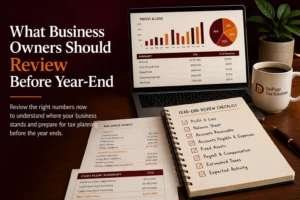
Learn what business owners should review before year-end to understand where their business stands, prepare for tax planning, and address financial issues while there is still time.
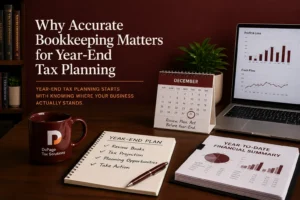
Year-end tax planning starts with reliable numbers. Learn how accurate bookkeeping supports tax projections and helps business owners evaluate potential tax-planning opportunities before year-end.
At DuPage Tax Solutions, our proactive tax planning services help business owners look beyond tax preparation. We review your current situation, project potential tax liabilities, identify planning opportunities, and help you understand the steps required to implement appropriate strategies.
Schedule a consultation to discuss year-end tax planning for your business.
Ph. (630) 909 9700
Email: DPTax@DP-Tax.com
Mail address:
1552 Illinois Rte 59 #1037
Naperville, IL 60564
Mon: 11 am – 7 pm
Tue: 11 am – 7 pm
Wed: 11 am – 7 pm
Thu: 11 am – 7 pm
Fri: 11 am – 7 pm
Sat: 12 pm – 5 pm
Sun: CLOSED
© 2024 DuPage Tax Solutions | Site Map | Privacy Policy | Disclaimer