Year-End Bookkeeping Checklist for Business Owners
Use this year-end bookkeeping checklist to review your accounts, transactions, payroll, and financial statements so you can start 2027 with clean, current books you can rely on.
Tax, Accounting, & Advisory Services
Tax, Accounting & Advisory Services
DuPage Tax Solutions provides tax preparation, accounting, bookkeeping, and proactive tax advisory services for individuals and businesses.
Based in Naperville, IL, we serve clients throughout the Chicago metropolitan area and nationwide through our secure, remote-first approach.
Licensed professionals. Reliable financial information. Proactive guidance throughout the year.
Home » What Does Tax-Ready Bookkeeping Actually Mean?
Your bookkeeping may be current. Your transactions may be categorized, and your bank accounts may even be reconciled every month.
But does that mean your books are ready for tax planning or tax preparation?
Not necessarily.
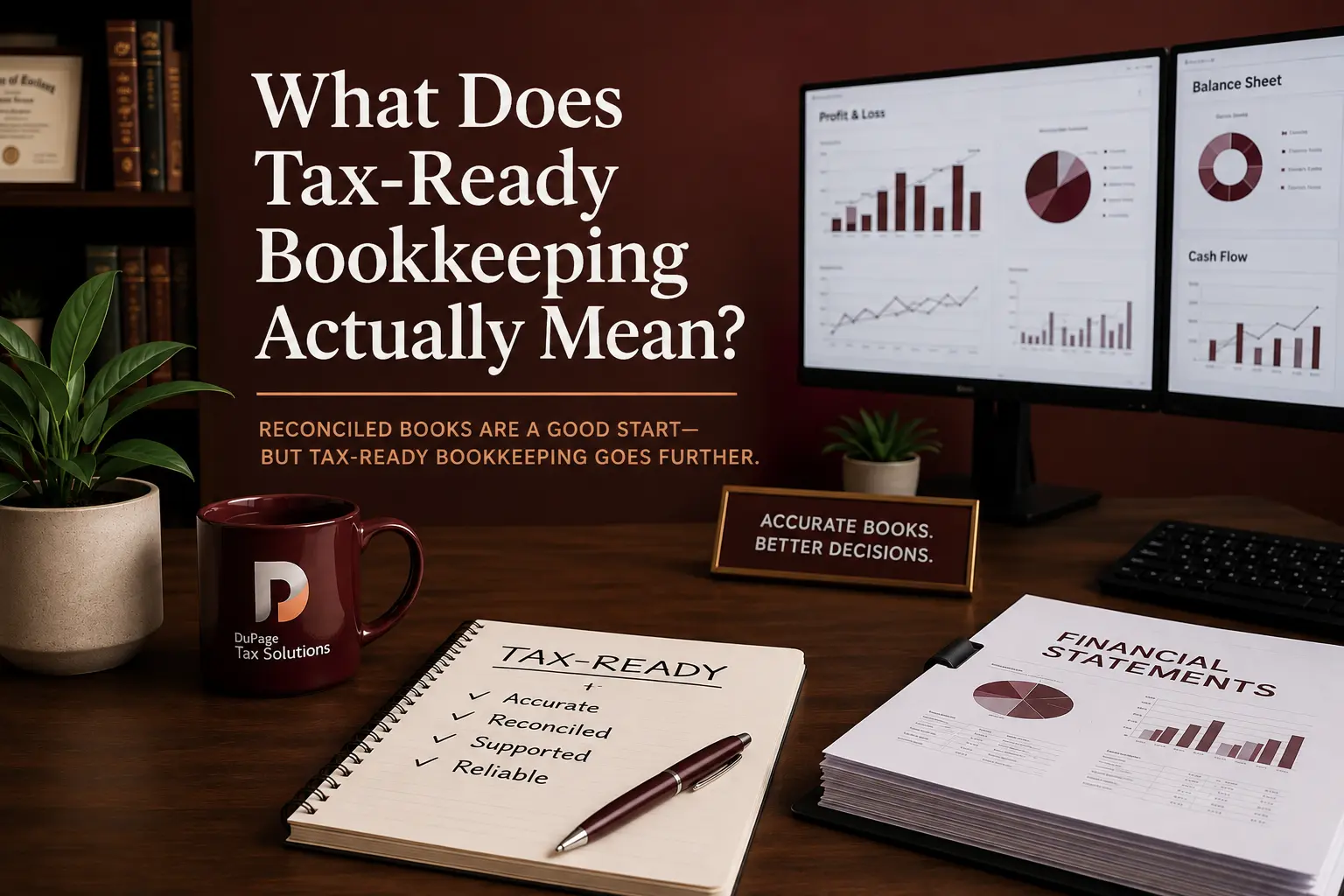
Tax-ready bookkeeping means more than keeping up with transactions. The numbers in your financial statements should be accurate, properly classified, and supported by the underlying records. Bank and credit card balances should agree with their statements. Loan balances should agree with lender records. Payroll accounts should agree with payroll reports, and unusual or incorrect balances should be investigated rather than carried forward month after month.
The goal is simple: your financial statements should accurately reflect what happened in your business and provide numbers you can rely on when it is time to plan or prepare your taxes.
Reconciliation is an important part of bookkeeping. It helps confirm that transactions recorded in your books agree with activity reported by your bank or credit card company.
But reconciliation alone does not establish that everything was recorded correctly.
For example, a transaction can clear the bank and still be:
In other words, a reconciled account can still contain accounting errors.
That is why tax-ready bookkeeping requires looking beyond whether the bank balance reconciles. Regular reconciliation is an important part of monthly bookkeeping services, but it is only one step in maintaining reliable financial records.
Bank and credit card accounts should be reconciled regularly, and their ending balances should agree with the corresponding statements.
Unexplained differences should be investigated rather than allowed to remain on the balance sheet.
Business loans require more than recording the payment leaving the bank.
Payments generally include principal and interest, and those amounts need to be recorded appropriately. The loan balance on the balance sheet should agree with the supporting lender records after accounting for timing or other reconciling items.
This becomes particularly important at tax time because interest expense and the year-end liability may affect different parts of the tax return.
If your business has employees, the bookkeeping should agree with the payroll records.
Wages, employer payroll taxes, employee withholdings, payroll tax payments, and related liabilities need to be recorded properly. Unexplained payroll liabilities sitting on the balance sheet can be a sign that something has not been recorded correctly.
Downloading transactions from a bank connection does not determine their proper accounting or tax treatment.
A bookkeeper still needs to determine what the transaction represents.
For example, money spent on equipment may need to be recorded differently from ordinary office supplies. A transfer between two business accounts isn’t income or an expense. Money contributed or withdrawn by an owner shouldn’t simply be placed in a miscellaneous category.
The transaction has to reflect what actually happened.
Tax-ready bookkeeping includes reviewing the balance sheet for balances that appear incorrect or need additional support.
That can include:
A profit and loss statement can look reasonable while the balance sheet contains significant problems.
Your tax professional uses your accounting records when preparing your business tax return and, when applicable, performing tax projections and year-end planning.
If those records are inaccurate, additional work may be required before they can be relied upon.
And inaccurate books can affect more than one number.
An incorrectly classified transaction could affect deductible expenses. An asset recorded as an expense could require correction. Incorrect payroll or loan balances may require investigation. Owner transactions can affect the balance sheet and, depending on the entity and circumstances, tax reporting.
That is why tax preparation shouldn’t be the first time someone takes a close look at whether the books make sense.
Tax-ready books aren’t only useful when preparing a tax return.
They also provide the starting point for tax projections and year-end planning.
Before evaluating potential year-end strategies, your tax professional needs reliable information about what has already happened in the business. Without accurate year-to-date numbers, a projection may be based on incomplete or incorrect information.
The process should work together:
Accurate books tell us where the business stands. A projection helps estimate where the year may end. From there, applicable tax-planning opportunities can be evaluated while there is still time to act.
And that’s particularly important toward the end of the year because some actions cannot simply be taken after December 31 and applied retroactively.
When bookkeeping is performed only to keep QuickBooks current, tax-related issues may not be discovered until the return is being prepared.
At DuPage Tax Solutions, we do bookkeeping with taxes in mind throughout the year.
That means maintaining the books isn’t simply about categorizing transactions and reconciling accounts. We focus on accurate, reliable financial information that can support tax preparation, projections, and planning when those services are needed.
Your books should tell you what happened in your business—not leave you and your tax professional trying to reconstruct it months later.
Learn more about our accounting and monthly bookkeeping services for businesses that want ongoing support throughout the year.
Use this year-end bookkeeping checklist to review your accounts, transactions, payroll, and financial statements so you can start 2027 with clean, current books you can rely on.

Learn what business owners should review before year-end to understand where their business stands, prepare for tax planning, and address financial issues while there is still time.
Year-end tax planning starts with reliable numbers. Learn how accurate bookkeeping supports tax projections and helps business owners evaluate potential tax-planning opportunities before year-end.
Being current is only part of the equation. Your books should also be accurate, reliable, and supported by the records behind them.
Whether you need help to bring your books current or want ongoing monthly bookkeeping, DuPage Tax Solutions can help.
Schedule a free consultation to see how we can help.
Ph. (630) 909 9700
Email: DPTax@DP-Tax.com
Mail address:
1552 Illinois Rte 59 #1037
Naperville, IL 60564
Mon: 11 am – 7 pm
Tue: 11 am – 7 pm
Wed: 11 am – 7 pm
Thu: 11 am – 7 pm
Fri: 11 am – 7 pm
Sat: 12 pm – 5 pm
Sun: CLOSED
© 2024 DuPage Tax Solutions | Site Map | Privacy Policy | Disclaimer